My daughter and I made a new friend in the backyard today.

My daughter and I made a new friend in the backyard today.
I fixed the SwiftoDo chrasher that I griped about this afternoon, and, to future-me’s chagrin, I stayed up late to do it.
Tracking down the problem was tricky, but I eventually discovered that UIDocument’s revert method was failing because sometimes it was being executed on a closed file. It turns out that I was not interrogating UIDocument.documentState correctly when checking for “closed” file state. The documentState property is an OptionSet, and has a contains method that is more appropriate to use than == for this purpose.
At least, that what I think right now. I’ll test my app out for a day or two and see if the nasty crash bug rears its head again, or moves to a new call site.
Transistor on iOS is a really good game. I started it around 11 PM last night and completely lost track of time until 12:30 AM. I am still doing pretty well with gaming on my iPad Pro with a controller, rather than buying a Nintendo Switch.
Today I was planning to submit to the App Store the current build of SwiftoDo, which I have been testing without incident for about three weeks. Unfortunately, out of nowhere, it started crashing on launch late this morning. Fortunately, I never finished submitting this build to the App Store for review, so it will never reach users. It does mean, however, that I have to debug a tricky treading-related crash before I can release the cool new feature I have been working on.
I have to decide if I’m going to end it, roll it forward month-to-month via an App Store subscription, or pay for an ultimately cheaper annual subscription via Marvel’s web site. I thought, for fun, I would start reading one comic book per day, and think that justifies the subscription price. I am enjoying the service, but I have, historically, only read comics in short, intense bursts every couple years, so I’m not sure if I will really stick with it once I read through the series I started. Of course, now I’m hooked on Brian Michael Bendis’s run of All-New X-Men, so I predict I will renew the subscription in some way.
I picked a bad week to try to fit 60 minutes of exercise and 120 minutes of overtime into every work day. 😂
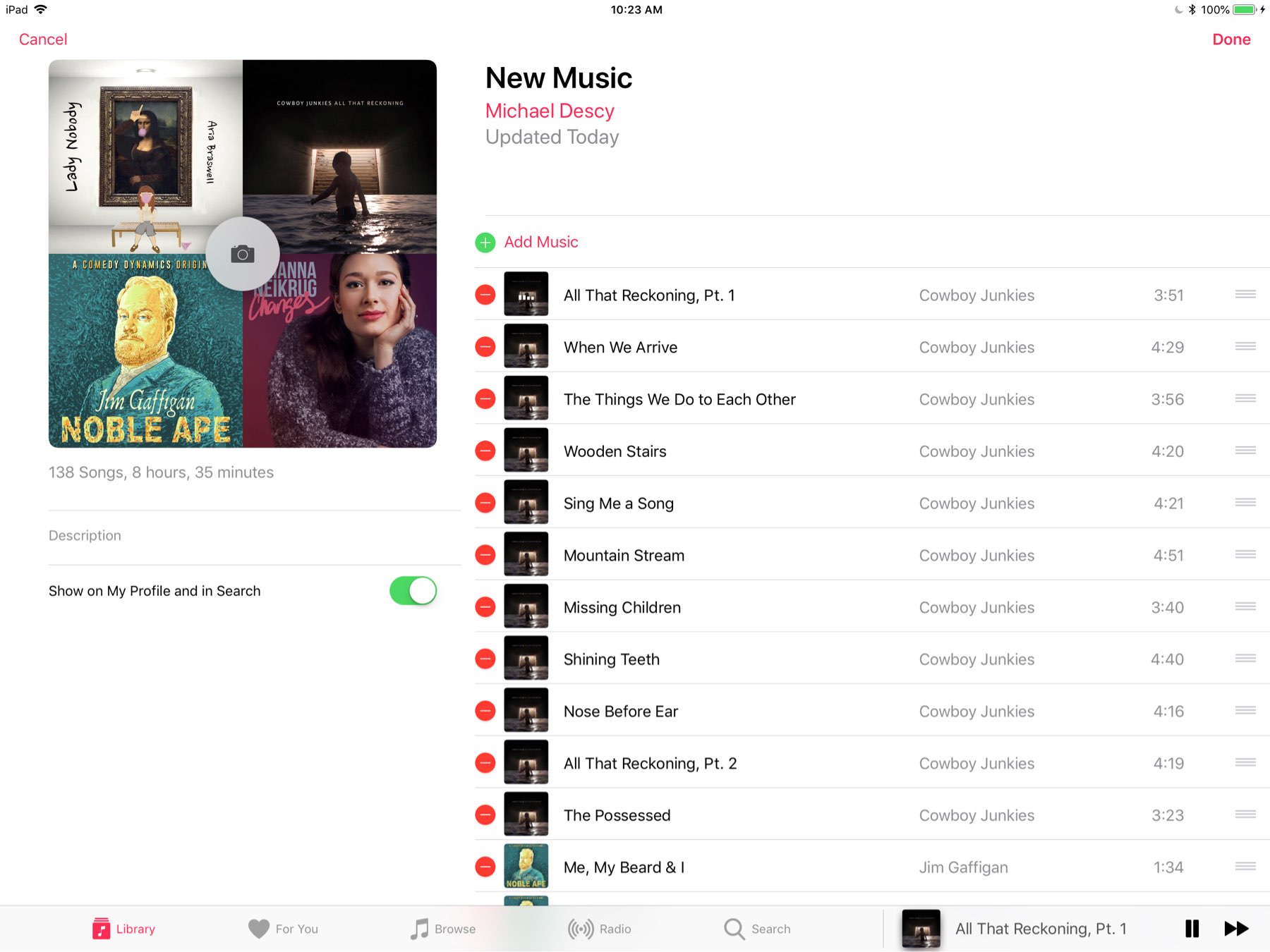
Apple’s Music app needs multiple selection on its playlist editor. It is tedious to remove albums I have listened to from my personal “new music” playlist. It is easier to manage on iTunes, but I hardly ever listen to music via my Mac anymore.
This blog post is a great overview of Mastodon.
In conversations I’ve had over the past week, it’s become clear that there’s nothing very self-explanatory about Mastodon as a social network, and that in many ways Twitter users are both prepared and unprepared for the experience. There are a lot of things that are similar in concept, but there’s more to it when it comes to how it’s a “service” that can really throw people for a loop.
I use Mastodon a little, but don’t really feel strongly one way or another towards the platform. I want to like it more. I was super enthusiastic about its predecessors, like StatusNet (nee Laconica, now GNU Social), but those failed to gain significant momentum, and became overrun with spam.
Despite whatever is new and exciting about Mastodon’s web UI, open web features, etc., it doesn’t feel that new or exciting to me. It feels like a better StatusNet. I suppose, though, that I care more about writing and posting content, and owning it, than about the ephemeral and chatty aspects of social networking.
I’m debugging iOS Files access in SwiftoDo this evening. It feels like ages since I worked on this app. During my 2-week vacation, I was exploring UI and navigation ideas I have for a future version of SwiftoDo.
I bought my iPad Air 2 almost a year after it was released, only a few months before the first iPad Pro was released. I was a little worried at the time that I would get only a couple years out of it before iOS updates rendered it obsolete. I have been pleasantly surprised that that day has not yet arrived—and, based on how the iOS 12 beta is running, that day will not arrive for at least another year.
Last night, I finally installed the iOS 12 beta on it, and found the new OS to be smooth, stable, and fast. All my apps (even the ones I wrote!) are working just fine. As Apple promised, UI and animation-related things like scrolling are visibly faster and smoother, too.
I plan to install iOS 12 beta on my iPhone 7 Plus in early September, after I complete my next release of SwiftoDo. Based what I’m seeing, performance wise, on my even-older iPad Air 2, I’m looking forward to at least one more year of service from my iPhone 7 Plus, too. (It helps that my phone has a brand new battery and a new screen, thanks to AppleCare Plus.)
Dark Sky released a ground-up rewrite of their flagship iOS app today.
The most noticeable change is the introduction of a new unified timeline. Rather than separating the forecast onto multiple pages, we now combine the current conditions, next hour rain forecast, next 24 hours, and next week forecasts into a single scrollable view that lets you quickly get to the part of the forecast you care about. This makes it much easier to scan what will happen in the minutes, hours, and days ahead.
Dark Sky version 1.0, which was singularly focused on precipitation warnings and maps for your immediate vicinity, was probably my favorite iteration of the app. It wasn’t a full-fledged weather app at the time, but its singular focus was useful for me whenever I wanted to step out of the house or office.
I have been using Weather Line, which uses Dark Sky weather data, almost exclusively for the past couple years, because its information layout was denser and more useful. This update may bring me back to Dark Sky, however. I’m moving it back to my home screen and will give it a go.
I am fully back from vacation now, trying to get back into the swing of things at work. Fortunately for me, I had good people covering for me, and almost nothing I had to do for work over the past two weeks. The mad rush will resume today, I’m sure. 😀
After enjoying the Philips Revolution speaker dock for a while, I started to look for a better sounding iPod dock. I found that in the Altec Lansing M650, which is a 2.1 channel system (yes, stereo speakers plus a tiny, down-firing subwoofer!) in a compact, triangular case, with a 30-pin iPod/iPhone dock on a ledge in front.
I thought, and still think, that it sounds great. Its sound is warm, rich, and natural. While I wouldn’t consider the bass response to be very tight, or there to be any stereo separation at all, it does sound really nice, and can fill a small bedroom or a home office with a pleasant sound that I could listen to for hours on end.
I used one as my main desktop stereo system for a couple years while I worked from home. It replaced my Harmon Kardon Soundsticks, which sounded better for music, but were not as easy to connect to my iPhone. It sounds great for music, podcasts, and for TV—thanks to its line-in jack, I often plugged an iPad into it for better audio when watching baseball or Netflix. I liked this speaker so much that I bought another one for the kitchen, where it was a great base station for phone charging and playing internet radio for several years.
Unfortunately, while this speaker sounds great, its 30-pin dock is poorly implemented. After several months, both speakers emit annoying static from the 30-pin connector unless the iPhone is seated just right. I think I’m the only one in my house who knows how to fiddle with it until the sound clears up. Plus, of course, the 30-pin connector was made obsolete by Apple’s change to the Lightning standard.
I still use both of my M650s in my children’s rooms to play white noise while they sleep, and occasional music while they are awake, through our old iPhone 4 and 4S. It has gotten increasingly difficult to seat an iPhone on them without getting static through the 30-pin connection, but it is still possible. However, because the 30-pin iPhones that drive them are old and barely work at this point (software-wise), these speakers’ days as iPhone docks are numbered. They have a line-in jack in the back, however, and are prime candidates to pair with an Amazon Echo Dot (or something similar) sometime in the future.
I finally bought MarsEdit 4 today!
My vacation is almost over.
The iPod had a monumental impact on how people listened to music. Not only did it turn people onto digital music downloads, rather than CDs, better than any preceding product; it also made listening to playlists and to shuffled music simple and extremely popular. The iPod’s 30-pin connector had a huge impact on home speaker systems as well. Suddenly, it became the default connection option for a bevy of home speakers. In stores, many speaker systems were repealed by iPod speaker docks.
While I had iPods since the first iPod Mini was released, shortly after I got married, I got an iPod Touch. It came for for free with my wife’s first MacBook Pro, and she had no interest in it. Of course, as a non-iPhone-owner, I found the iPod Touch to be an incredible upgrade from my iPod Nano. Around the same time, I got my first iPod speaker dock for free as well, in exchange for writing a review. It was a Philips Revolution speaker dock that looked somewhat like a boombox, could be driven by a bunch of D-cells or a power cord, and had a rotating dock that could accommodate (in portrait or in landscape mode) every iPod created to date and the first generation iPhone.
For sound, it was perfectly adequate. I liked it a lot at the time, but I thought of it like a boombox rather than a room-filling speaker system. It lacked a subwoofer, and thus had lackluster bass, but it was small, battery powered, and brought music into places in our apartment that it previously didn’t reach. My wife and I enjoyed using it with the iPod Touch for streaming music—mainly Pandora or streaming radio from WNYC—in the dining room while we ate dinner. I really enjoyed using it for background music during meals or for news radio, for which having the richest and best audio quality was not terribly important.
In the same way that my computer, once I got a CD-ROM drive, supplanted the stereo system as my main music player, this speaker system solidified the iPod’s (and later the iPhone’s) prime position as the source for music in my house. It also got me into the habit of streaming audio into the house, rather than only playing previously downloaded (or ripped) music. My wife and I used it in our kitchen for years to stream WNYC news and music. When the iPhone changed from the 30-pin connector to the Lightning connector however, this speaker dock’s days were numbered. And when that original iPod Touch’s software support was dropped by Apple, this speaker dock’s days were done.
In my mid 20s, I decided to move from boring (but nice) suburban Connecticut back to the Boston area where I went to college. It was a chance to reinvent myself, which is something I really needed to do at the time.
In the process, I replaced a lot of my belongings—cheap things or hand-me-downs that I had since my college days—with newer, better versions. I replaced nearly everything I cooked with and ate with: dishes, pots and pans, and small appliances. I bought a new wardrobe and got rid of my ratty old T-shirts and jeans. I traded up from a slow and struggling Dell tower PC to a sleek, fast, white MacBook (my first Mac!). I also traded up from my old, busted Altec Lansing computer speakers to the cool, futuristic Harman Kardon Soundsticks II that I saw in the Apple Store.
The Soundsticks’ clear plastic construction made them almost invisible. Their clear, light-up subwoofer looked like a bioluminescent jellyfish floating atop the tangle of wires under my desk. Their capacitive touch volume control was futuristic, too, but really hard to control; I mainly relied on my MacBook’s volume control instead.
In my cool, urban apartment, I played music through these cool, stylish speakers for hours and hours each day as I worked on my new MacBook (and on my work laptop, side-by-side). They sounded much better than my prior Altec Lansing computer speakers, but mostly they just looked better. I found that, at loud volumes, they didn’t really fill the room how I would have liked them, but I rarely played them that loud anyway, considering they were sitting on the desk I was working at.
During this time, I stopped buying CDs and started buying music online. I got into indie rock very heavily, mainly because I could get their tracks at great prices (25 cents per track) though eMusic. I first heard Okkervil River, Spoon, The Avett Brothers, The Apples in Stereo, Bright Eyes, Rilo Kily, Rainer Maria, and many, many other artists through these speakers.
I happily used these speakers for five years or so—even after moving from my hip, urban apartment to the suburban house I live in now—but I eventually tired of the mess their wires made atop and beneath my desk, and moved them into basement storage. Someday I hope to find another use for them, perhaps as a bookshelf system driven by a Raspberry Pi, but I would need to figure out a way to hide all the wires, so the great looks of these speakers shine through.
Over winter break, during my sophomore year in college, I bought my first new computer: a beige Dell tower with an Intel 486 processor. When pricing out systems—and this was done over the phone back then, rather than over the internet, because my parents did not have internet access in 1997—I configured nearly identical systems from Gateway and Dell at the same price. The only difference between them was in the peripherals: the Gateway came with a 19-inch monitor, rather than a 17-inch monitor, and the Dell came with a USB-connected, 2.1 channel Altec Lansing speaker setup. I bought the Dell, to get the better speakers.
At the time, I thought the trade-off was completely worth it. The speakers were tiny, stylish, had some fancy USB connectivity (USB was brand new then!), and came with a subwoofer, which I had never had before. The subwoofer added a new dimension to my music that I had never experienced before. It could shake the room if I wanted that, or just add some sub-bass dimension to the music. Its presence inspired me to pair this speaker set with my old, 2-channel Altec Lansing computer speakers, to create a 4.1 channel setup that I used to watch DVDs in my dorm room in 1999 and 2000. I had to upgrade my sound card to a Sound Blaster Audigy to get that to work. (I think that is the last dedicated sound card I ever bought!)
Their USB connection was not all I had hoped for, however. It did not carry the audio signal; it only allowed you to control the volume and EQ from a Windows menu bar application. It was pretty sophisticated for the time, but it was superfluous, and, I discovered after a year or so, the drivers that made it work caused Windows to crash all the time. So I disabled the USB feature and continued to use them for about 10 years, through college, grad school, and beyond. Eventually they wore out so badly they could no longer play at a proper volume. By that point, though, I had moved onto using an iPod for most of my music playback.
I got my first computer when I was in seventh grade. It was an IBM AT/XT that we upgraded several times over the years. By the time I was in high school, my dad bought me a SoundBlaster sound card and some 6-inch computer speakers. I actually do not remember who made them: it was either JBL, Creative, or Altec Lansing. What I do remember is that they were the generic beige color of all PC hardware of the era, the right speaker had knobs for balance and volume, and, as a pair, they could go very, very loud. No one else I came across had computer speakers that large or that loud.
Sound quality-wise, however, they were not great. Back then, in the late 1980s and early 1990s, it was still rare to hear any sounds at all coming out of a computer. It was enough to be able to hear the beeps and blips coming from my DOS-based productivity software and games.
Due to lackluster sound quality, and the fact that CD-ROM drives were too expensive for me to buy until the mid 1990s, these computer speakers never replaced my CD system’s speakers as my main playback system. They are important to me, however, because they enabled me, for the first time, to use the computer to record and mix music.
A week before I left for college I bought a Sony boombox to use as a bookshelf stereo. It had detachable speakers, so you could actually achieve stereo separation, and, of course, “mega bass”, which was pretty much mandatory for good sound in such small speakers.
I chose this particular model because it had an analog 3-band equalizer, as opposed to several genre-specific settings; I relied on the EQ to pick out guitar and bass parts I would transcribe. As a bonus, it didn’t have a crazy light show like the many of the other boomboxes on sale in 1996.
I don’t remember very well how it sounded, to be honest, because I wasn’t able to use it that much. My freshman year roommate and I did not share musical tastes, so I had to play my music through my computer using headphones. (My computer’s CD-ROM drive actually had a dedicated “play” button and its own headphone jack.) I didn’t realize it at the time, but all those hours listening to music over headphones (the cheapest headphones possible, I’d say) in my dorm room were the very beginning of my headphone-centric music listening preferences.
My parents bought me my first CD player at the JC Penney Outlet. It was a damaged, open-box, no-name system that resembled a single, tall unit. It contained, from top to bottom, a turntable (though the clear cover was broken off and missing), an AM/FM radio, a five band equalizer, a dual deck cassette, and a single cd player at the bottom. The only reason I asked for it, and thought my family could afford it, was because it was damaged and was being sold at a steep discount. I also told my parents I would listen to classical music on it, which was my intent, but didn’t actually happen too often.
It came with two bookshelf speakers with RCA inputs that plugged in the rear, that I set up about ten feet away from the receiver. I couldn’t tell you how good or bad the sound was. All I knew at the time is that it was amazing compared to what I had at the time: my mom’s 20-year-old transistor radio, and a cheap, toy-like boombox with a dual cassette deck. The most important upgrade, of course, was upgrading from records and tapes to CDs. CDs didn’t have tape hiss, had high dynamic range, and didn’t wear out over time or get eaten by the plater sometimes.
I blasted music through this no-name system for hundreds of hours through middle school and high school. I measured my school papers by how many album listens it took to write them. I used it to practice singing, to transcribe songs with my guitar, to play back 4-track recordings, to lie back on my bed with CD liner notes while my favorite new song played on repeat.
I amassed an enormous CD collection, mostly through the Columbia House and BMG Music clubs, and partly through weekly trips to my local record store (which is long gone now).
Now that I’m a parent, I am amazed that all my loud music playing didn’t drive my parents crazy. They never complained to me about my music blasting from 3 PM to 10 PM every day. My kids are too little to listen to music on their own, but I’m already thinking about which headphones to get them, so we can all coexist in the house.
I have no idea where this system went or who made it, but, based on it being my first CD player, it is probably the most important speaker system I have ever owned.
I love music, and I love headphones, but, oddly enough, I have no special love for speakers. The reason, I suppose, is that, since I was a broke teenager living with my parents, I have never had the opportunity to listen to loud, room-filling music at my home. Roommates, sleeping children, and close neighbors have always prevented it. That said, my love of music has always depended on speakers, and, as I got older, they got a little better over the years.
I’m going to publish a short series of posts about the various speaker systems I’ve had over the years. After that, I will post a short series of posts about all the headphones I’ve had, and loved, over the years, as well.
I rewatched “Avengers: Age of Infinity” and my loved it. I actually liked it better the second time. If 20-year-old me knew that nearly-40-year-old me would prefer comic book movies to nearly everything else…I don’t think we would be friends.
Today is the big trip up north in the car. It’s a 5-hour trek that somehow takes my family 12 hours or so each year.
I’ve got only 5 days until vacation. Hopefully I can shift gears from programming and data work for my day job back to writing and coding for my hobbies.